
Musings 11192025
on love, worth, the value of human connection, and rewatching The Materialists
Wednesday November 12th was one to write home about. Well, at least in my journal. The day ended in one of those rare, only in New York kind of ways.
Exhausted from my day, I exited the train, breathing in the crisp November air near midnight, checking my surroundings as I went deeper into my neighborhood. Serendipitously I ran into a coworker, fresh from his workout, and as we crested the hill and rounded the corner onto the cozy, main stretch of avenue we ran into two more acquaintances. The four of us lingered, the traffic lights changing from red to green and back again, and we reintroduced ourselves, gossiping about the woman who let her bath run, the ordeal leading to a leak into a local pizza joint to one member of our quartet, an OG native, telling us how things used to be on this particular block. Minutes before the clock struck midnight, I bid my farewell, and now I’m still thinking about the unplanned interconnectedness that transpired that day.
The 12th of November started bright and early. A staff meeting hyping us up going into the busy, holiday buying season. While yes I’m a TV and Film writer, things have been rather bleak, and like any true transplant still trying to ‘make it,’ possibly with naive hope that she will, day jobs are a life saver. In this particular meeting we discussed the personable ways we can distinguish ourselves from the big box shop up the street. Trying to stay present in the meeting of course, I couldn’t help but wistfully chuckle, day dreaming that I’m living out a You’ve Got Mail plot that won’t end with the demise of the small, local shop around the corner. “They want to be on our side,” my boss said. “So let’s show them that behind the counter and on the floor, we’re one of them.” That human touch and connection and all that jazz…
Shortly after, I found myself scurrying across Herald Square, dodging the madness of midtown, taking a quick moment to snap a picture of the already decked out Macy’s Christmas decor to send to an out of state friend, when, in retrospect of course, I found myself sitting across from my therapist discussing the topics of dating, the perception of self worth, and how to navigate the possibility of finding ‘your person’ when surrounded by the inarguable truth of many a failed match. Breakups. Divorce. Abuse. Take your pick.
Back at home, I stayed cozy in my oversized sweats, doom scrolling in bed, editing the words and photographs for my previous Substack, gossipping with my building’s gravel voiced handyman as he inspected the radiators (where I learned of the aforementioned lady and her bathtub), and hemmed and hawed over going back outside into the cold (I love the cold but I also love staying cozy too) to attend a guild screening for awards season. After all, I’d already seen the film and had quite the knee jerk reaction to it. But the invite said “in conversation with Audra McDonald,” which, made no sense to me — perhaps it wasn’t thee Audra — but something told me to go. So I did.
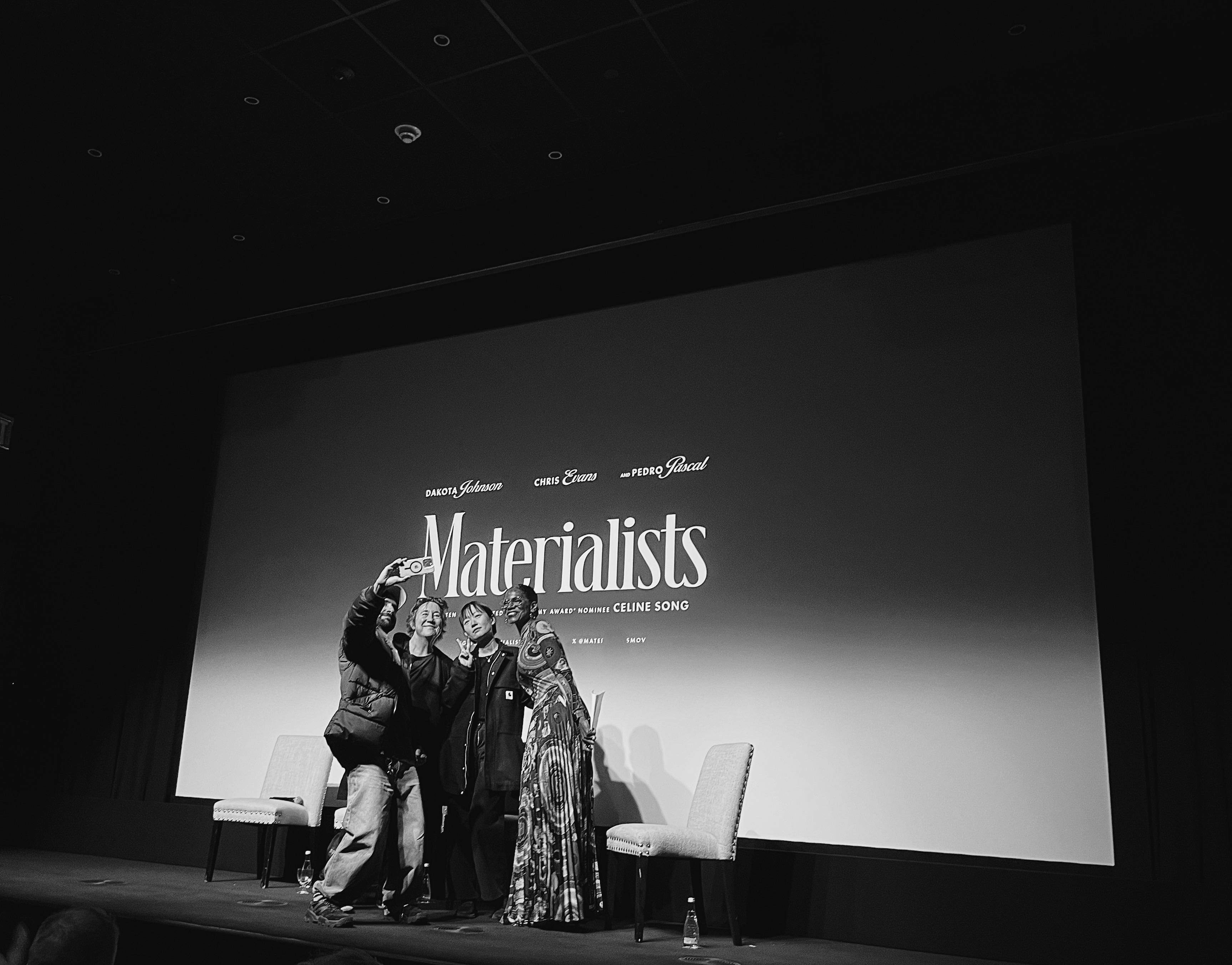
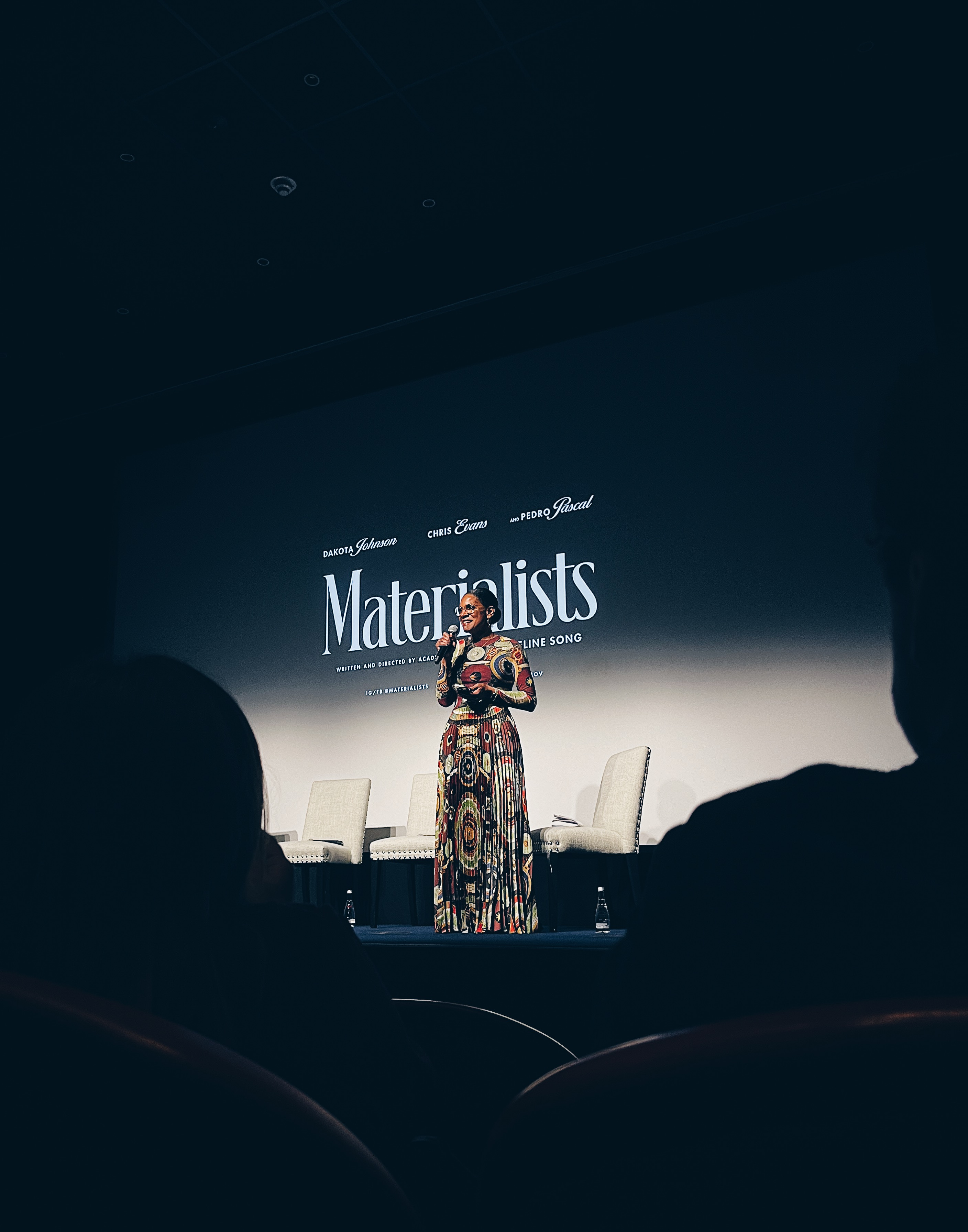
Reemerging back in Manhattan, the sun now set, I weaved through the cobble stoned streets of SoHo to get to my destination. I passed familiar haunts from my care free 20s, stopped inside Min & Mon out of pure curiosity (their designs are so whimsical and fun!), and finally found myself descending the posh, hardwood stairs of the Crosby Street Hotel to attend a screening of The Materialists in conversation with Celine Song and Audra McDonald. And yes, it was thee Audra McDonald1.
Like a lot of you, when I first saw The Materialists, I gasped a the ending. It felt like a whiplash, unexpected, complete 180 when, spoiler, Dakota Johnson’s Lucy says yes to ex-boyfriend John’s (played by Chris Evans, Netflix’s Warrior Nun’s Alba Baptista’s husband) sunrise proposal. As the Gen-Zers were saying, it was giving Broke Boy Propaganda. But on the 12th of November, after the lights went up and the credits rolled having now seen it a second time (fun fact, Celine pointed out that the Marriage Bureau overhead shot was filled with the film’s crew and execs, the real couples of the people who made the movie!)2 and before the Q+A (I want to emphasize that I was not influenced by Celine and Audra’s words), I had an aha moment.
Going into this screening, now armed with knowing the ending before the film began, I made it a point to search for Lucy’s emotional arc. When did she stop doing ‘the math,’ and let love lead? And folks, it wasn’t necessarily in the dialog. It was in the silence, in her eyes, in her actions, or inactions, the subtext… I finally saw what Celine wrote on the page. But to point to a moment, a line, upon second viewing I finally caught/felt/saw the turn when a. Lucy calls John about the botched Sophie date/assault over confiding in and being vulnerable with Pedro Pascal’s Harry and b. after Lucy confronts Harry about his scar —
Lucy: Harry, you don’t want to marry me.
Harry: But isn’t marriage a business deal?
Lucy: Yes, it is. But love has to be on the table.
I think in that moment she realized this ‘love element’ for the first time as did the audience (me, the second time around). After that moment, I kept watching Lucy. Despite in later scenes her doubling down on the fact that she is judgmental, materialistic, and cold. That she broke up with John because he was broke. That she doesn’t want to spend the rest of her life in his shitty car, eating at cheap restaurants, fighting over $25, you could see that Lucy’s dialog did not match her emotions and actions for the rest of the film. I didn’t notice this upon first watch.
Later, during the Q+A, Celine tells us the most important line in the film, its thesis, comes from Zoe Winters’ character Sophie.
“… I am not merchandise. I’m a person. And I know I deserve love.”
On finding ‘Lucy’ in Dakota Johnson, Celine said —
I wish there was a complex reason for it, I wish I could kind of sort of put a name to it, because Dakota is able to embody the thing that we’re talking about which is this cynical hard shell, that if you break it, inside is this totally gooey extremely emotional and very sensitive person. And I’d say that about all three of them (Dakota, Chris, Pedro). The three of them understood. They (Lucy, John, Harry) understand better than anyone, they want to show up and say I’m not merchandise I’m a person. Love is when both sides see this.
Audra asked, “You said your writing process is about chasing a feeling that you don’t quite understand. What feeling were you chasing with The Materialists? And what feelings do you think you will chase with other films that will come after this?”
Celine’s response:
The main thing that I was chasing was the way that so much of my language about love was starting to sound more and more like I work in finance. I think that this is happening pretty globally for all of us in the way that we’re being asked to be humans. Because I’m really feeling it a lot — which of course this movie is about the dating market. This dating market which of course we know has been around since, Jane Austen novels are all about the dating market. So we know it’s always something we’re always contending with, the way we’re evaluating each other as life partners and turning each other into products, merchandise, and commodities. But then there’s another way that we, it happens to us all the time — think about the way we talk about the job market. We always talk about how we always have to be valuable. So valuable that no one can fire us. So there’s always this fear based way that we think about ourselves as a value object. And I think I was starting to see the way that kind of language was sneaking into my own personal life or my life in general. I started to talk bout people I work with, people in my life, in terms of value as if they’re objects. But I know the truth of the whole thing — which is that all objectification of human beings is going to lead to dehumanization. It’s always going to lead to something quite violent… and we see that play itself out in what happens to Sophie and what Harry does to his body. So I think the thing I was also asking about was, How is it at the end of the day that we can still walk out of this in love with each other? How is that actually possible? To me - I think you can see it from the beginning to the end. The financial language around love is consistent. The final line of the whole film, How’d you like to make a very bad financial decision? And I wanted to talk about that more than anything…. and now that we’re all here (coming together to watch this film about finding love, at screenings, in the theatre, etc) what I was always interested in was to have a proper conversation. The conversation I wanted to have with this movie is, What is our solution? What are we trying to do with the way we’re thoroughly and completely trying to objectify each other and eventually that’s going to turn against ourselves. Eventually we’re going to have to objectify ourselves and then we’re going to have to remind ourselves, I’m not merchandise. I’m a person. So I think that to me that was always the guiding principle of it… If you’re asking me what I was trying to face in this movie, I’m trying to face my own self hatred. Which I think self hatred is the most intimate thing we have. I think about how when you get deep enough in a relationship you have to accept in front of the other person how much we hate ourselves. So I think that was something that made me feel quite vulnerable making this movie. That’s the relationship I have with this movie.
Which brings me back to the morning staff meeting. The emphasis on human connection. Rejecting the notion that as retail workers, we’re immune to the dehumanization customers at times put upon us. That when you say, “Well I can get it cheaper on Am*zon,” that it doesn’t sting each time. We have feelings. We’re human. And upset that you’re flaunting your willful ignorance of the proven economic impact (subsidizing of goods) and denying the reach of the dollar when shopping local.
From the shop around the corner to my therapist’s couch, the theme continued on —worth, value, and how we talk to ourselves and about each other. How, perhaps, now, I see the fault in viewing ourselves and each other as value objects. Like in the movie, when Lucy ‘loses it’ with a client saying that she’s not building a car or house, that, “We’re talking about people. People are people are people. They come as they are.” I was reminded that we have to be gentler and kinder with our faults and flaws that don’t necessarily ‘fit’ the daydream that we’re chasing for ourselves or within others. Especially when mindlessly swiping left and right.
Rewatching The Materialists was like cooking with day old rice. It was a better experience in that I knew what was going to happen and so I was able to watch the film for what it was, understand it, and appreciate Celine’s intent given the initial impact. Too — the way Audra and Celine were fangirling over each other was just so wholesome to watch. May Audra moderate more film panels.
Takeaways form the second watch:
Finding and understanding Lucy’s subtextual emotional arc that went zipping over my head upon first blush.
Viewing it with the lens of satire/commentary, especially around the literal lengths Harry will go to to find understanding, partnership, and hopefully love.
Being ok that now having experienced Lucy’s arc, it’s ok, if, in my opinion, John still could have put action over words (it wasn’t his movie, this was Lucy’s).
All the foreshadowing!
Now wanting to dust off my own Past Lives / The Photograph3 inspired screenplay and take another stab at it…
Quotes I loved from the unexpected evening:
“To live in New York City just to survive you have to be very realistic, and very cynical, and very tough, and have a big hard wall up… but on the other hand, why do you live in New York City? Because you have dreams… because you believe that you’ll be the person who makes it, that you’ll be the person that figures it all out. So there’s an amazing kind of like idealism and dream and fantasy element which is of course juxtaposed with the thing that we actually have to do which is the every day always having to be cynical, tough, and realistic.” - Celine Song
“The only answer to love is that you have to surrender. As a modern person who has a job and has to be in control, it’s always fascinating to me that this one realm of knowing nothing and giving in is the answer to life’s problem.” - Celine Song
—
As always, stay safe and sane out there. Know your rights. And thank you for reading.
m.
I once cried quite uncontrollably while watching Audra perform in concert at Carnegie Hall. And if you haven’t seen her in the zoom rendition of ‘The Ladies Who Lunch’ alongside Christine Baranski and Meryl Streep, please abandon this substack and hit play now.
Celine said it was shot toward the end of the shoot and it was nice because by this time, everyone knew each other, were comfortable with one another. That, “On set, props, Izzy, my favorite moment is when she hands everyone their bouquets because that’s her job and in the end she gets her own bouquet then walks into the scene. Gosh, it was so romantic!”
Stella Meghie’s sophomore film starring Issa Rae, Chanté Adams, LaKeith Stanfield, and Y’lan Noel — here’s the trailer. Meghie’s debut, Jean of the Joneses, is also a fun treat.